
Where work actually happens
Start inside the live service environment instead of opening with abstract AI claims.
Messy tools, queues, handoffs, founder decisions, and the private operator console.
Valdris.aiMost teams bolt AI onto chat or dashboards. Valdris starts with how the work actually runs: workflows, owners, handoffs, tools, data, and review gates. Then it installs AI-native operating systems your team can run every day.
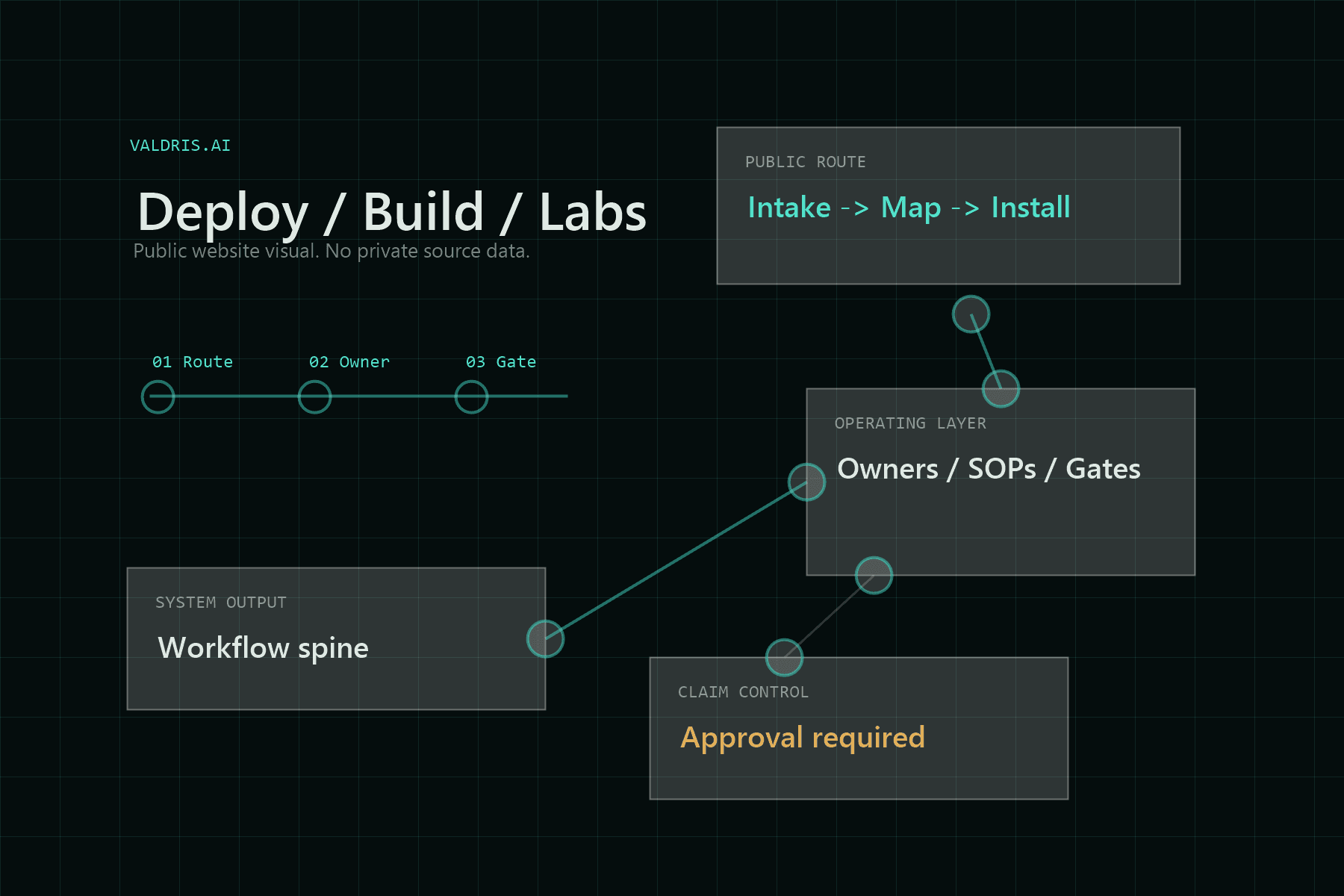
Deploy is the first step: install the operating layer. Build follows when the workflow needs software, agents, integrations, or dashboards. Labs researches custom models, evals, prototypes, and decision systems when off-the-shelf tools are not enough.
The install should be legible without a long explanation: start with where work happens, surface the details that prove the system is real, then move the request through action, gate, handoff, and cadence. Motion only ships when it clarifies state.
Start inside the live service environment instead of opening with abstract AI claims.
Messy tools, queues, handoffs, founder decisions, and the private operator console.
Show the small operating artifacts that make the install feel grounded and auditable.
Intake fields, route labels, owner chips, SOP rows, calendar handoff, and proof lock.
Every visual move should advance the workflow, assign responsibility, or close a gate.
Request enters, route draws, owner is assigned, AI assist appears, human gate locks.
Slow down proof and risk; speed up activation and handoff only when the state is clear.
Ambient startup, signal ticks, route pulse, gate lock, weekly operating cadence.
Create more visual states than the final page needs so the system never feels faked.
Wide context, macro detail, over-shoulder operator, route close-up, final lock state.
This is not a software menu. It is one deployment-led path: install the operating layer first, build custom systems only when the workflow needs them, and use Labs as the R&D engine behind scoped work.
Install the operating layer
Turn recurring delivery workflows into routes, owners, handoffs, AI assists, QA gates, source-of-truth rules, and weekly operating cadence.
Build only what the workflow needs
Create internal tools, dashboards, agents, automations, integrations, and workflow portals when existing tools cannot carry the operating requirement.
Applied R&D behind Deploy and Build
Research, fine-tune, evaluate, and prototype custom model, reliability, and decision-system capabilities that support scoped Deploy or Build paths.
Valdris moves teams from scattered AI experiments and founder memory into named routes, owner accountability, review gates, and operating cadence.
The install turns live work into owners, states, handoffs, AI assists, QA gates, SOPs, snapshots, and a weekly decision loop.
Map the three priority workflows, owner gaps, current tools, founder-router moments, and baseline operating state.
Define the operating spine inside the existing work system: states, owners, handoffs, SOPs, AI assist points, and review gates.
Move live work through the new workflow spine with AI-assisted specs, updates, reports, and human checkpoints.
Stabilize QA gates, escalation paths, OS Owner handoff, founder pulse, and the next operating backlog.
Valdris can explain the install path without exposing client records, source maps, proof reviews, or private operator systems.
Public pages explain the service, process shape, and approved contact path — not private operating records.
Operator routes, admin routes, source maps, and private APIs stay behind access control.
Public receipts exclude submitted personal fields, internal record identifiers, and query-string data.
Public outcome material stays gated until each claim, source, and surface clears review.
Public outcome proof publishes only after each claim, source, and surface clears approval.
Best fit: founder-led service teams where delivery still depends on hidden routing, scattered tools, and memory.